
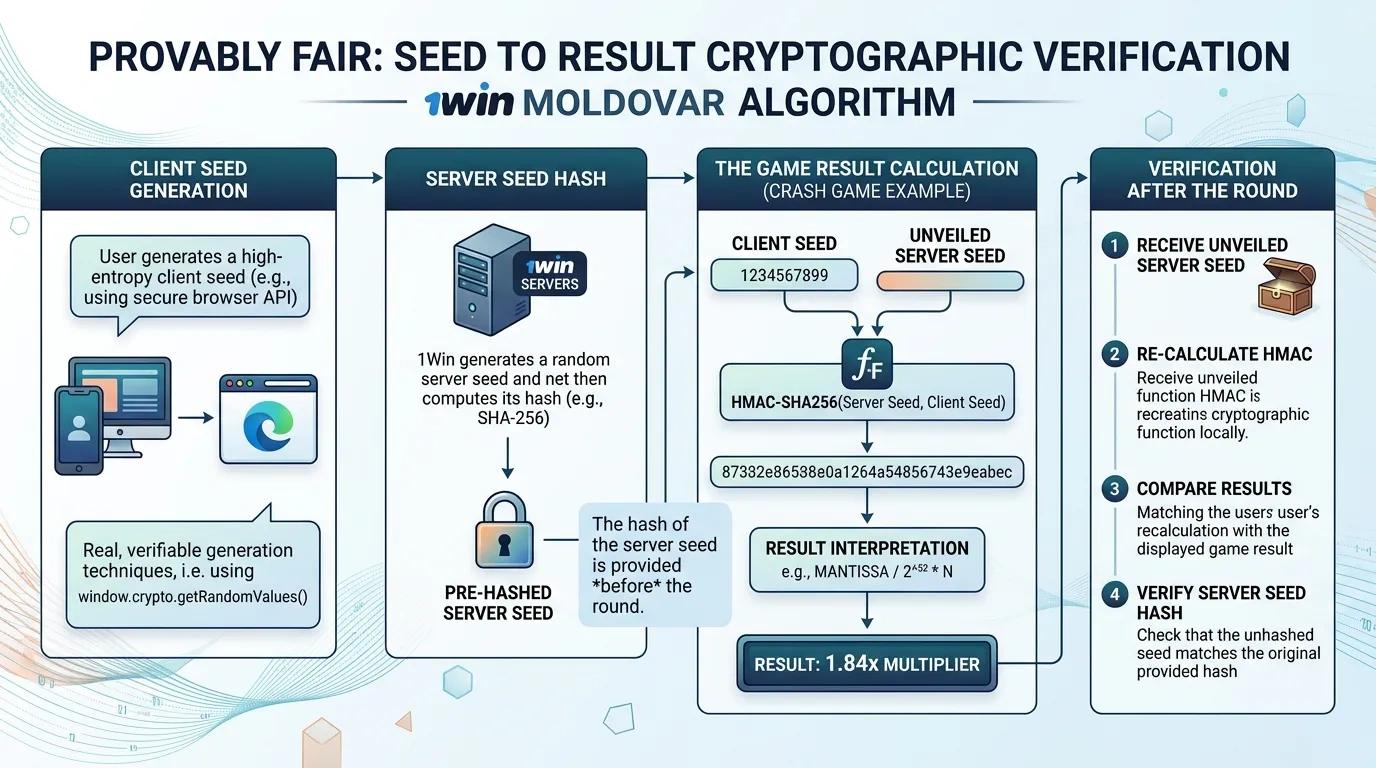
At 1Win Moldova, users can verify results after each betting session, and the outcomes of each betting session are secured with cryptographic techniques. The algorithm at https://1win-bet.md/ is built on the server seed, the client seed system, and a nonce, with the hash function used to generate results being SHA-256. While the system is designed to allow users to verify results post-session, it also ensures that every round remains traceable.
How does the seed system work?
At 1Win Moldova, users can verify outcomes and every step of the system post-session. The fairness of the Algorithm Design is based on three components: server seed, client seed, and a nonce, which is used to keep track of each betting round. The results of the betting round are generated using the SHA-256 hash function, and the outcome is revealed at the end of a betting session.
- Initially, the system does not disclose the server seed.
- The player is responsible for sending the client seed.
- Each round is signified by the nonce.
- The system employs the SHA-256 algorithm to combine the inputs.
- Results are produced by reading the bytes from the hash.
- This process validates each and every calculation by comparing the new output to the original values.
Using seeds, how do players retain control?
1 Win Moldova players are able to retain control by allowing the device to generate a new seed at the beginning of each session. The players have control of the session values as well as of the formats and of the ways used to generate new seeds.
- The device generates the seed autonomously;
- The browser is set to use string values by default;
- The players have control over the seed format.
- As the format is set to hex or ASCII, the session uses one seed only;
- A type change necessitates a new seed;
- The device contains past seeds;
- A new seed is generated each time a change occurs.
- The players control the direction towards the result.
Server seed management:
The back-end system uses seeds to create anchors, fixing the order of results for each betting round. Once the betting round is concluded, operators are unable to modify the result chains.
- Backend generation creates values and those values are made up of exactly 64 hexadecimal characters.
- Everything operates on randomness, and more bits means more possibilities in each draw.
- The system executes a hash on the server before a player begins game play, and it is the player’s responsibility to ensure they verify the draw utilizing the hash against the server’s seed.
- The system creates a value in the form of a seed, which is temporary and the system tracks every update to it.
- In order to ensure a fair betting system, seeds are only valid for one betting round and the value of a seed will not change unless a new betting round begins.
- Risks are mitigated by controlling how a player’s data is stored in the database and the protection mechanisms that are enacted using access control and drives.
- Each value is in the database. Every betting operation can be traced and is linked to the account, which makes the operation of the system completely transparent.
- Controls avoid collisions and ensure that outcomes are fair and independent.
Client Seed Updates
Players can change these values using the account interface at 1Win Moldova. If a player changes a seed, the nonce counter is reset to 0. Modification rules are stricter for client seeds, which are typically shorter than server seeds.
- The length will remain short in most cases;
- A random function determines the first value. This function relies on the use of entropy to achieve fairness;
- Some seeds contain a part of a timestamp. This adds unpredictability;
- The character set uses letters and numbers. It does not include symbols;
- Players are allowed to modify the data for a session. This modification is optional;
- Updates for each round occur less frequently;
- Players are allowed to export a text file copy. This is a precautionary measure to address data loss when players use a different device;
- An individual nonce, combined with a seed, renders the input unique. This ensures that each round of the same game is different, even if the other parameters are the same;
- The server combines the values and then performs the hash. This method protects the inputs of both the server and the client;
- The values are always displayed in the account panel, which allows players to verify the values at any time;
What is involved during the hash process?
Three variables are required for a single hash: a seed from the client, a seed from the server, and a nonce which are integrated and processed through a hashing algorithm. In the 1Win platform, this system performs a hashing function at the end of every betting process to confirm the results and maintain the integrity of the operations.
- Each outcome is generated by a standard and orderly sequence of operations.
- The first operation involves combining and sequencing the server and client seeds.
- The client seed follows the server seed immediately with no space in between.
- Then the numeric value of the nonce is added.
- The combined string of the seeds and the nonce is processed through the SHA-256 hash function.
- The output size of this function is equal to 256 bits.
- The output of this function is then transformed into a digest.
- The next step is to understand the digest in hexadecimal format. Different types of games apply different rules at this step.
- For dice games, the algorithm takes a character from the start of the hexadecimal digest to produce the outcome.
- For slot games, different segments of the hexadecimal digest are transformed into numbers that determine the position of the reels.
- For card games, the hash is divided into several segments and then analyzed as numbers that relate to the cards in a deck.
Seed mapping examples
Concrete examples outline each step. Three variables change as cryptographic functions run and give results that users can check. The process uses SHA-256 hashing because this method links the server seed, client seed, and nonce.
- The server seed is 64 characters;
- The player seed is 16 characters;
- Each nonce starts at zero;
- The system sets the nonce to zero for the first game round;
- The process combines these parts in sequence: the server seed first, the client seed next, and the nonce last;
- This input moves to the SHA-256 function;
- The function outputs four bytes in hexadecimal form;
- The system converts these hex bytes to an integer;
- That integer fits within the possible outcomes of the game. The system uses it to set the result;
- All later rounds use the same formula.
Repeated seed scenarios
When the server seed, client seed, and nonce stay the same from one round to the next, the outcome does not change. The system returns the same result every time the same inputs appear.
Several technical considerations govern seed reuse: Seed reuse requires clear technical guidance. Developers establish these rules to keep results predictable and fair.
- Same seed and nonce repetition creates duplicate hash results across different sessions;
- Identical hash results confirm deterministic algorithm behavior during verification checks;
- Operator reuse avoidance prevents server seed duplication through automated generation systems;
- Player reuse allowance permits client seed repetition without compromising fairness;
- Nonce reset prevention ensures continuous counting even after client seed changes;
- Parallel game contexts maintain separate nonce sequences for simultaneous game types;
- Race condition handling uses indexed round identifiers to resolve timing conflicts;
- Timestamp log storage records exact moment when each seed pair activates;
- Verification possibility remains intact regardless of seed reuse patterns;
- Documentation policies define rotation intervals and acceptable reuse scenarios.
Algorithm boundaries
Provably Fair systems use strict technical boundaries. Each limit is clear and enforced. Every function stays within its set domain.
The algorithm scope encompasses distinct verification domains: The algorithm scope includes separate verification domains. Developers design these layers to prevent overlap and reduce risk.
- Outcome generation: Full cryptographic coverage;
- Randomness validation: Hash-based entropy confirmation;
- Integrity checking: Seed and result matching;
- Account balance exclusion: Financial transactions separate;
- Network issue separation: Connection problems independent;
- Interface bug independence: Display errors unrelated;
- Off-chain process separation: Payment flows outside scope;
- Blockchain variant storage: Alternative proof methods exist;
- Pure server models: Standard 1Win Moldova implementation;
- Recorded round verification: Only logged sessions checkable;
- Unlogged action exclusion: Undocumented rounds cannot verify.